★★★★★
Three contractors wanted to replace my 1950s boiler. Rescue's tech diagnosed a $400 zone valve. It's been running fine for 2 years now.
A dead boiler in January isn't a Monday-morning problem. We answer around the clock, send a licensed master plumber rather than a salesman, and carry parts for the systems that are actually in North Jersey basements.
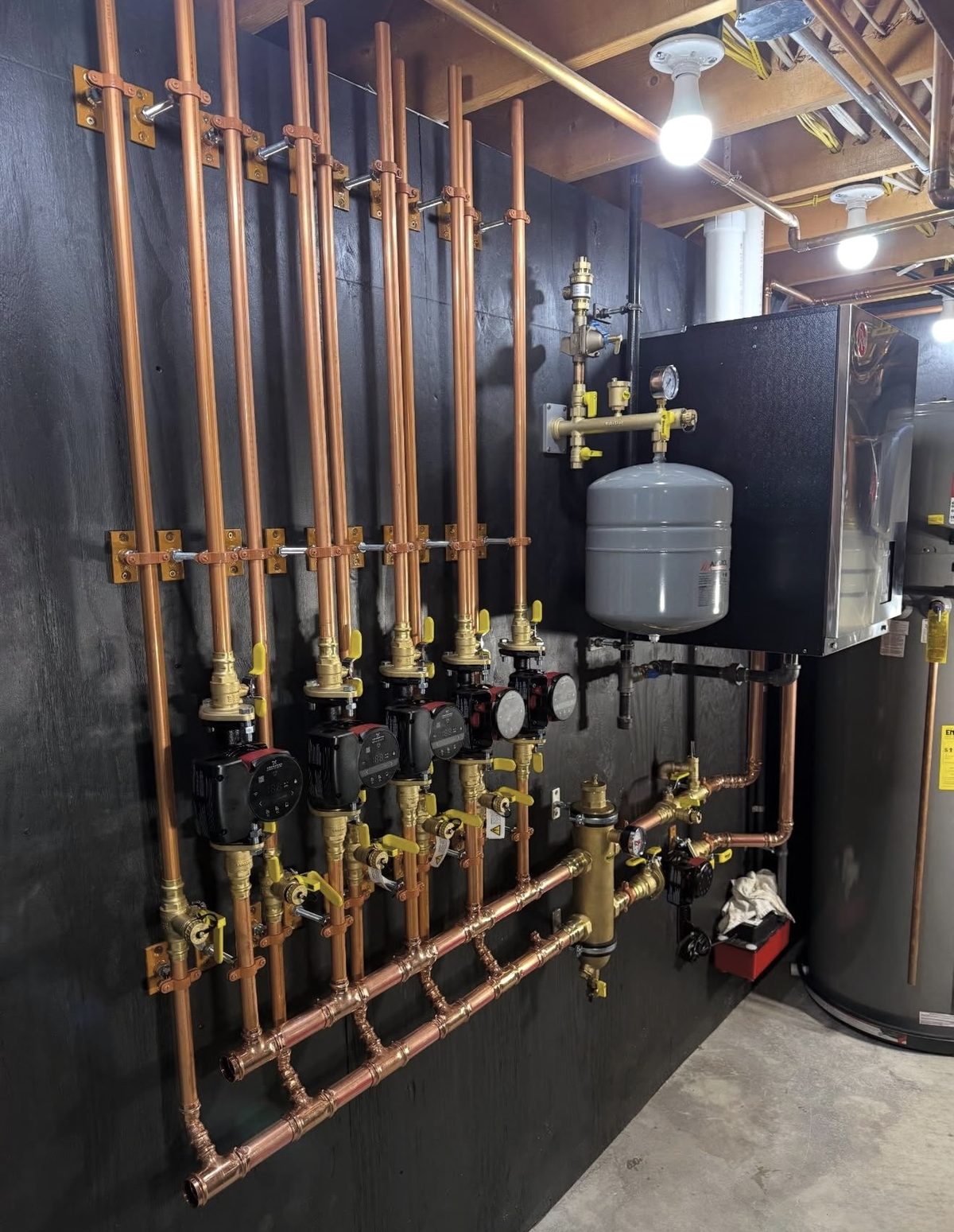
Look at the pipework
Boilers mostly fail at the joints, the controls and the piping around them. So that's where we spend the time. The photo above is one of ours.
None of this shows up in a sales brochure and all of it decides whether you're calling somebody back in eight years or twenty-five. Every joint gets pressure-tested before we close up, and the workmanship is warrantied for a year — two on premium installs.
Shut the system down if you can reach the switch safely, open doors and windows on your way out, and get everyone into fresh air. If anyone is dizzy, confused, sick or drowsy, call 911 first. Carbon monoxide is odourless and it does not announce itself.
Then call us. We carry a combustion analyser on every truck and we can tell you within minutes whether the system is safe to run. Anything over 50 ppm in the flue means combustion is incomplete, and that's a stop-work number, not a wait-and-see one.
Start here
Tell us the symptom on the phone and we'll put the right parts on the truck before we leave. Pick yours below.
Four usual suspects and they're all diagnosable on a meter. The low-water cutoff is the one people forget about, and on an older steam boiler it's often the answer. Most of these are back on within the hour.
Heat reaching half the house is a distribution problem, not a boiler problem. We put a manifold gauge on it and find out which zone isn't moving water. Usually sorted in one visit.
Steam meeting standing water in the mains. Failed traps, wrong pitch on a main, or wet steam coming off the boiler. Old Paterson, Newark and Jersey City houses do this constantly and it isn't something you have to live with.
The first two are repairs. The third isn't — a boiler that was too big for the house on the day it went in will short-cycle for its whole life, and no part changes that. We'll tell you honestly which one you've got.
Cheap to fix if you catch it early, and we carry them. If the pilot keeps dropping out after a new thermocouple goes in, the next thing to look at is draft, and that's a combustion issue worth taking seriously.
Help me choose
If you're at the replacement stage, this is most of the decision. Cast iron outlives everything. Mod-con costs less to run. Combi saves you a water heater and a corner of the basement.
| Feature | Cast Iron | High-Efficiency (mod-con) | Combi Boiler |
|---|---|---|---|
| Best for | Existing radiator homes Longest life | Lower running cost | Replacing old and saving space |
| Efficiency | 82–86% AFUE | 92–96% AFUE | 94–96% AFUE |
| Lifespan | 15–25 years | 15–20 years | 12–18 years |
| Install cost | $8,995–$13,995 | $11,995–$18,995 | $10,995–$16,995 |
| Gives you hot water? | Separate tank needed | Separate tank needed | Yes, it's built in |
| Footprint | Large, on the floor | Wall-mount possible | Wall-mounted |
Flat rate, no bait
Real ranges. You get the final number on site after we've diagnosed it, in writing, and nothing starts until you say so.
Prices reflect typical ranges in Northern NJ as of 2026. Permit fees, awkward access and emergency hours move the final number, and we tell you before we start rather than after. Replacements are quoted from a heat-load calculation, not from the size of the old boiler. Workmanship is warrantied 1 year, 2 years on premium installs, and manufacturer coverage typically runs 10 years with a 12–25 year heat exchanger, registered by us on the day. NJ Master HVACR Contractor Lic. #19HC00145700 · bonded · insured.
How the visit goes
Any hour. You describe what the system is doing and we tell you straight whether it's a tonight problem or a this-week one.
Not a sales rep working from a tablet. You get told what's actually wrong, including when the answer is "less than you feared".
Flat rate, written down, before anything comes off the truck. Most boiler faults get fixed on that first visit.
Combustion analysis, pressure check and a leak test. You get the numbers, not just a thumbs up on the way out.
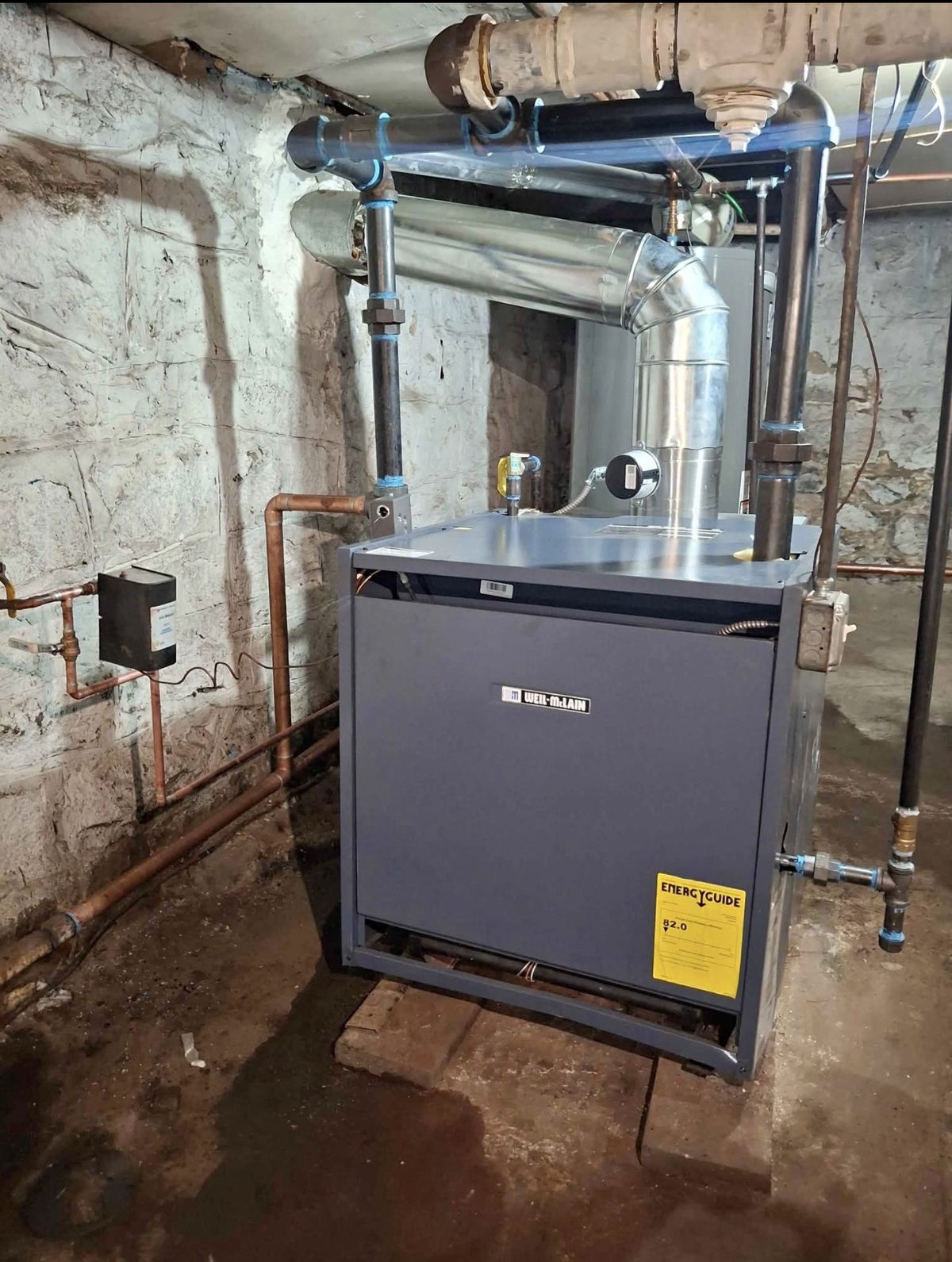
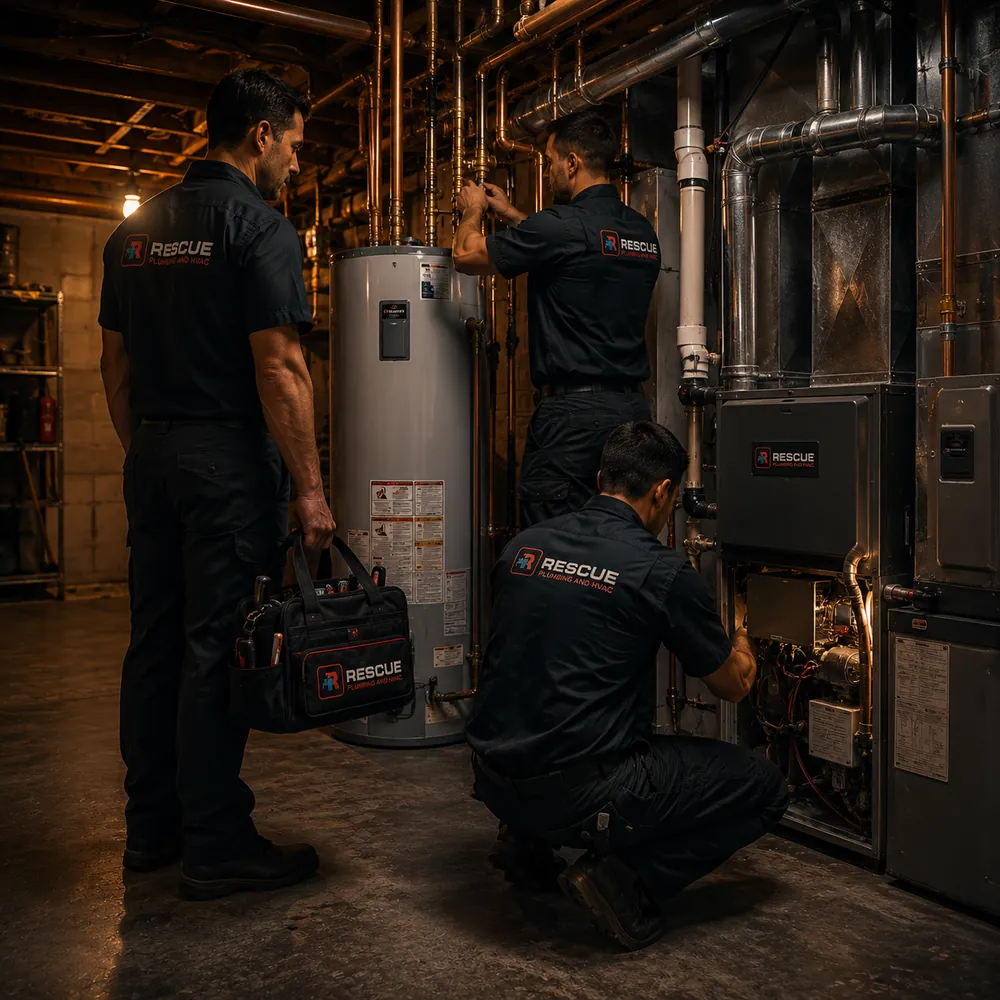
Real work
Real customers
4.6 across 445 Google reviews. Three of them below.
Three contractors wanted to replace my 1950s boiler. Rescue's tech diagnosed a $400 zone valve. It's been running fine for 2 years now.
Steam boiler kept short-cycling. They figured out the low-water cutoff was failing — replaced it, recalibrated the pressure, problem solved in 90 minutes.
Did our oil-to-gas conversion. Permitted, inspected, all paperwork delivered. Tank pickup coordinated. We saved $1,800 in heating costs the first winter.
Most repairs land between $189 and $895. Thermocouple $189–$249. Zone valve $385–$525. Aquastat or control board $485–$895. Circulator pump $595–$895. Everything is flat-rate and written down before we start.
Cast-iron replacement $8,995–$13,995. High-efficiency mod-con $11,995–$18,995. Combi $10,995–$16,995. Steam boiler replacement sits in the same range as cast iron depending on the near-boiler piping involved. Every quote comes after a heat-load calculation on site, not from the badge on the old boiler.
Tier 1 towns — Haledon, Paterson, Clifton, Hackensack, Teaneck, Hawthorne, Newark, Montclair — are 60 to 90 minutes at any hour. Tier 2 — Mahwah, Morristown, Parsippany, Wayne — is 2 to 3 hours. Dispatch runs 24/7/365 from our Haledon HQ and December-to-February no-heat calls get priority over everything else.
A direct replacement on the same fuel and similar capacity is one day. Cast iron to mod-con is a day and a half to two, because it needs new venting and condensate piping. Oil-to-gas is two to three days with the gas line and tank decommission. A full hydronic system replacement runs two to four.
Yes — 0% APR for 12 months on jobs over $1,500 through GreenSky or Synchrony, and longer fixed-APR terms on bigger work. Soft credit check, no impact to apply, and it stacks with rebates.
Air trapped in the lines, a stuck zone valve, a failed circulator pump, or a valve somebody closed years ago and forgot. We put a manifold gauge on the system to find which zone isn't moving water. It's usually sorted in one visit.
Water hammer. Steam is hitting standing water in the mains. Causes are failed steam traps, a main that's lost its pitch, or wet steam coming off the boiler. It's very common in pre-1950 houses in Paterson, Newark, Jersey City and Montclair, and it isn't something you have to put up with.
A failing thermostat, a dirty heat exchanger, or a boiler that was oversized for the house when it went in. The first two are repairs. The third isn't fixable with a part — it needs a correctly sized replacement, and we'll tell you if that's what you're looking at rather than selling you a control board.
If it's running reliably and the gas bills are sensible, there's no rush. Cast iron routinely goes 25 to 30 years. The moment to run the numbers is when a major component fails — a heat exchanger or a control board — because that repair cost gets weighed against a replacement rather than considered on its own.
Repair if it's under 15 years, the failure is a single component like a pump, valve or aquastat, and the fuel use looks normal. Replace if it's over 20, the heat exchanger is cracked, the jacket is leaking, AFUE is below 80%, or you've had several major repairs in two years. We'll quote you both so you can see the gap.
We measure CO in the flue gases with a combustion analyser. It should read under 50 ppm. Anything above that means combustion is incomplete, which is both a safety problem and a sign something is wrong mechanically. We do it on every visit and you get the number.
A modulating-condensing boiler condenses the flue gases and varies burner output to match what the house actually needs, instead of running flat out and shutting off. That's 90–95% AFUE against 80–83% for a standard unit, and on a typical North Jersey home it saves somewhere around $300 to $600 a year. It needs PVC venting and a condensate drain, and it suits homes already on natural gas with sensibly sized radiators or baseboard.
For cast iron: Burnham, Weil-McLain and Crown are the bulletproof ones, 25 to 30 years. For mod-con: Navien NCB, Lochinvar Knight, Burnham Alpine and Triangle Tube Prestige. On multi-zone hydronic homes around here we fit more Navien NCB combi units than anything else.
If natural gas runs down your street, almost always. Oil costs roughly twice what gas costs per BTU in New Jersey, and payback on the conversion usually lands between four and seven years. NJ Clean Energy rebates are often $500 to $1,500 on a conversion. We handle the tank decommission, and the soil testing if the tank is buried.
Yes, and plenty of them. One-pipe and two-pipe systems both. We replace boilers, repair them, fit vents, replace pigtails and rebuild near-boiler piping — which is the part most shops get wrong on a steam job and the part that decides whether the system is quiet.
Only if they need it. Cast-iron radiators generally last forever and work fine with a modern boiler. We'd replace one that's cracked, leaking, or badly undersized for the room. Baseboard fin-tube runs $385–$685 per section, and we size anything new off a heat-load calculation.
Both, depending on the job. Most new manifold work is pro-press: cleaner, faster, no torch in your basement, and a joint that holds up. We still sweat in tight spaces and when repairing existing copper where pressing isn't practical.
Always — it's required under the NJ Uniform Construction Code. A mechanical permit runs $75 to $250 depending on the township, plus an electrical permit on most installs, and we coordinate the inspection. A boiler installed without a permit voids the manufacturer warranty and causes real problems with insurance and at closing.
NJ Clean Energy pays $300 to $1,200 on 95%+ AFUE mod-con boilers. PSE&G and JCP&L utility rebates typically add $100 to $500. The federal tax credit runs up to $600 on qualifying high-efficiency systems. We file the paperwork rather than handing you a form.
Cast iron, installed and maintained properly: 25 to 30 years. Mod-con and condensing units: 15 to 20, with the electronics being the limiting factor rather than the vessel. Annual maintenance — combustion analysis, burner clean, flushing the low-water cutoff — meaningfully extends both.
Manufacturer parts coverage is typically 10 years on premium boilers with a 12 to 25 year heat exchanger, and we register it on the day of install because it doesn't start until somebody does. Our workmanship warranty is 1 year, 2 years on premium installs, with a free return visit if anything fails in the first year.
Coverage
Nine stocked Sprinter vans covering 47 towns across Passaic, Bergen, Essex, Morris, Hudson and Union counties.
You might also need
Call it in. A real dispatcher answers, and a master plumber gets sent.